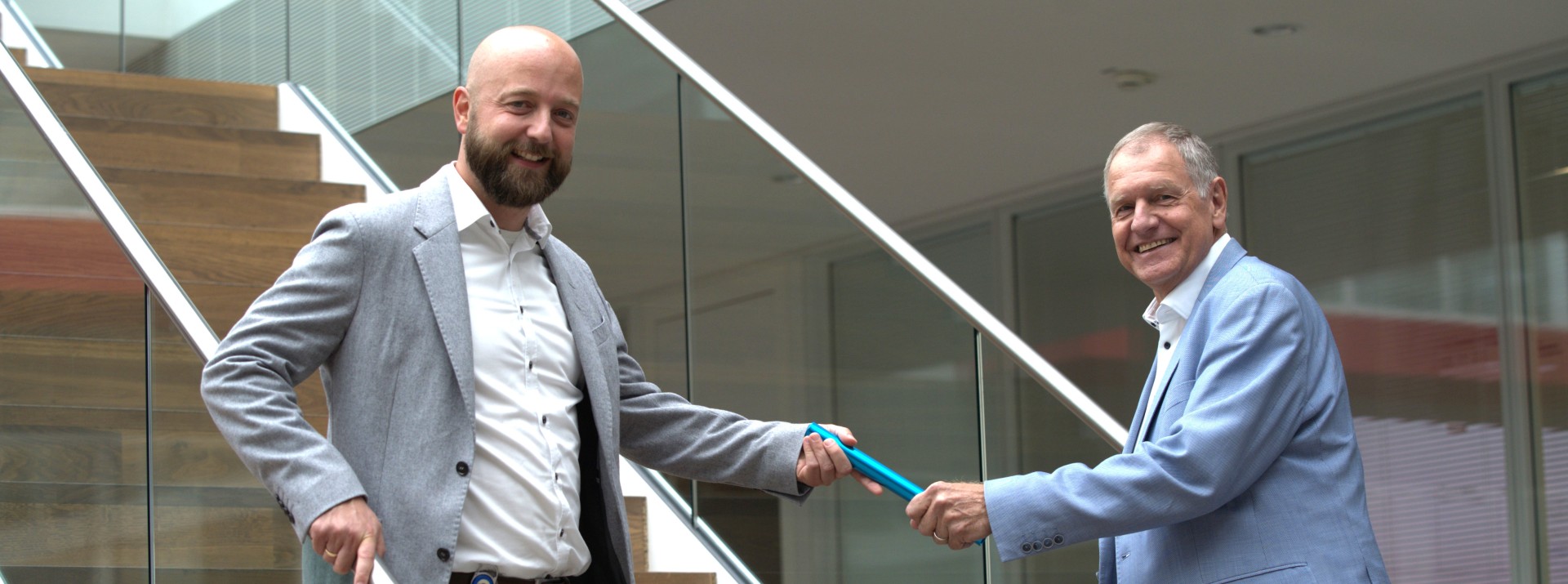
As Head of Modernization and Approval Strategy at Knorr-Bremse Rail Vehicle Systems, Johannes Gräber (right) spent more than ten years serving on various committees covering pan-European interoperability. Following his retirement at the end of the year, his role will be assumed by Felix Jakob, Head of Public Affairs | Research & Technology, Innovation Management. | © Knorr-Bremse
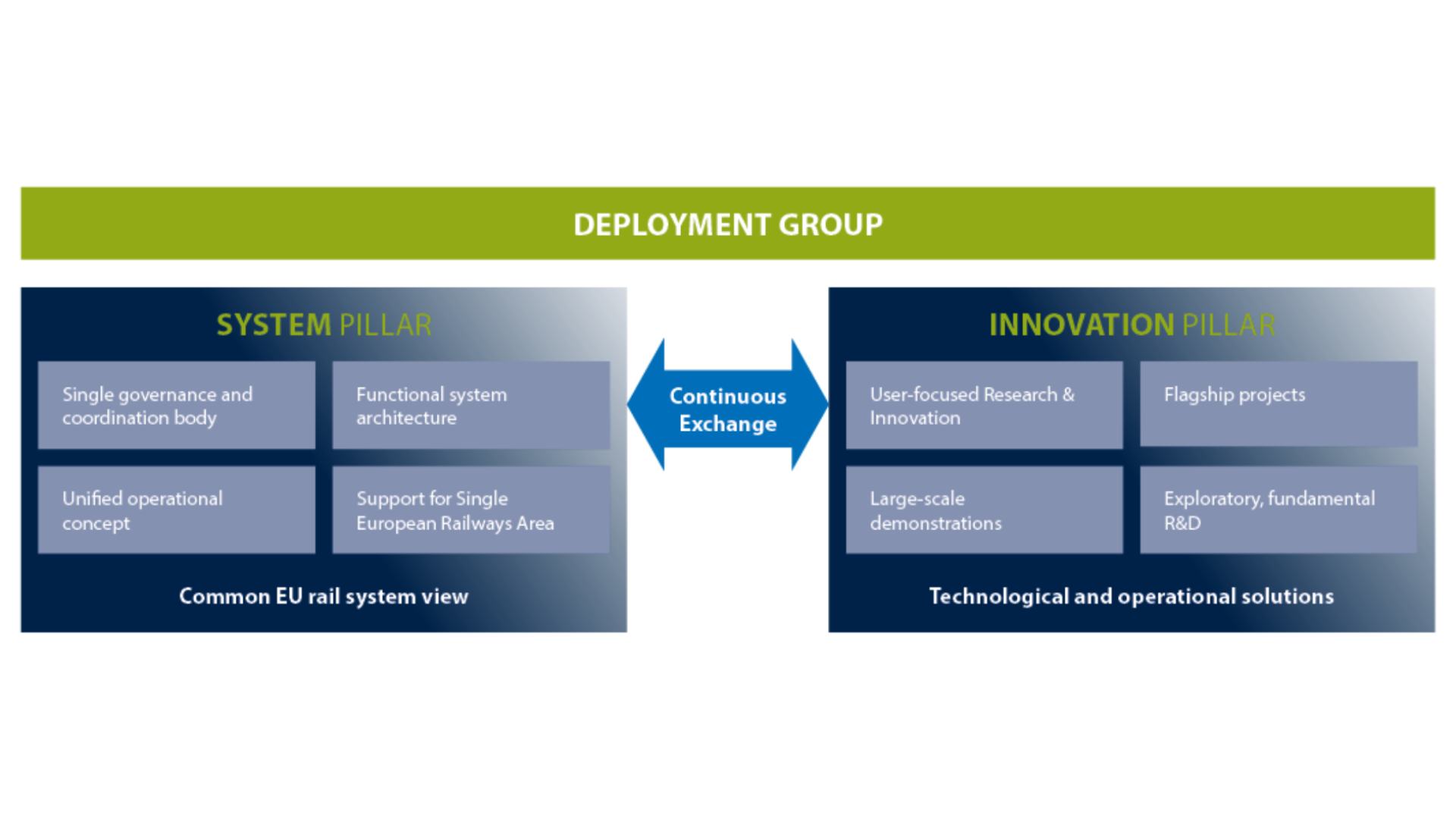
With the System and Innovation Pillars, the EU and Europe’s rail industry have developed an innovative project architecture for the Europe’s Rail Joint Undertaking (EU-Rail). This is giving new impetus to the development of common standards – and could become the key to an integrated pan-European rail system.
Across Europe, operating procedures for coupling trains differ widely, often resulting in interruptions or operational pauses. Under the Europe’s Rail Joint Undertaking (EU-Rail) – successor to the Shift2Rail undertaking launched in 2021 – Europe’s rail industry has been developing a standardized, pan-European scenario that will enable trains mto automatically brake and adapt to the vehicle-specific coupling speed specified by the ETCS travel authorization.
The coupling scenario is just one of many projects on which the System Pillar’s “Operational Harmonization” domain is currently working. Its remit is the comprehensive standardization of the operational regulations currently in use across Europe. Five further technical working groups are involved in the development of Control, Command and Signaling (CCS) technology. Key areas of activity include the “Railway System” (as a whole), “Traffic & Capacity Management,” “Harmonized Diagnostics,” and the Digital Freight Train. The latter includes “Full Digital Freight Train Operations” (FDFTO) – covering, for example, Knorr-Bremse’s active development work on the Digital Automatic Coupler (DAC). The aim is to boost collaboration on technologies and strengthen the bonds between the various actors in Europe’s rail sector.
Cross-sectoral working groups are developing common standards
“With the launch of the EU-Rail, we’ve also switched over to a new project architecture for the System Pillar, through which we’re driving the top-down transformation of Europe’s rail sector into a unified whole. Step by step, we’re dismantling existing technical barriers,” explains the Head of the System Pillar, Ian Conlon. This is based on a cross-cutting process: Rail and infrastructure companies, manufacturers and systems suppliers are working together in specialist teams to create harmonized guidelines and technical specifications for new standards governing, for example, ETCS and ATO. Operators provide details of their practical experience and requirements, while manufacturers contribute their technical expertise and ability to innovate. “This is producing solutions that match operational needs, are broadly accepted, and strike a balance between what people would love to have and what’s cost-effectively feasible,” adds the Head of the System Pillar. The underlying principle? As much regulation as necessary – as little as possible. The System Pillar Core Group is responsible for top-level management and includes, alongside rail operators and several major OEMs, Knorr-Bremse as a representative of Tier 1 suppliers. The current rail research program will run until 2027/28, after which it will seamlessly transition into the followup program under the EU’s 10th Framework Programme for Research and Innovation (FP10). Brussels has yet to decide whether to retain the revised project architecture. “But the positive experience gained thus far, plus the pace of progress – especially in recent months – are strong arguments in favor,” says Conlon.
“We know precisely where we’re going”
Mr. Gräber – in terms of policies, Europe is already very tightly integrated. Why is this still not the case in the rail industry?
During the rail industry’s early decades, countries deliberately designed their rail systems and infrastructures to be different from one another – often for reasons of military strategy in case of war. Because rail infrastructure is very durable, these national standards and regulations remained in place for many, many years. Unlike road or air travel and transportation, rail vehicles and the rail infrastructure are very tightly integrated, so it’s even more difficult to make technical changes – especially in view of the different safety philosophies involved. And of course, as time has passed, national sensibilities haven’t always worked in favor of faster European standardization.
You’ve been regularly involved in European committee work for some 30 years now. Was there a particular moment at which you said to yourself – now we’re really making progress with standardization?
I’ve never experienced a single, key moment – it’s always been more of a process. But looking back, the first railway package we developed during the 1990s and finally adopted in 2001 was a doubly significant milestone. On the one hand, because – for the first time – it provided clear guidelines to serve as the basis for common, pan- European rail industry legislation. And on the other, because the industry as a whole quickly realized that together, we’re stronger than if we each go it alone.
What do you regard as vital if these standardization plans are to succeed?
On the vehicle side, we’ve already come a long way. And now, with next-generation ETCS, we’re about to see a major step forward on the infrastructure side. Following System Pillar developments over the last few years in particular, I’m very optimistic: I’ve rarely seen such enthusiasm for genuine, pan-European harmonization across all the relevant committees – especially where the underlying operational regulations are concerned. In other words: We know precisely where we’re going.