
In Kazakhstan, passenger rail transit is heading in new directions: To create the comfortable, modern train services required to interconnect the country’s major urban centers, national rail operator Kazakh Railways (KTŽ) has ordered at least 537 sleeper and couchette cars from Stadler Rail. The vehicles’ braking systems will feature a new type of brake valve based on a GOST valve used in passenger cars and AAR freight cars. It also includes several UIC components and assemblies.
It is clear that Kazakhstan aims to become the Central Asian hub for rail freight. Of particular interest among the major infrastructure projects currently in progress are the Trans-Caspian International Transport Route (TITR) and the North-South Corridor. Kazakhstan is, after all, the world’s ninth largest country in terms of area, and already hosts five international rail corridors – among them the Middle Corridor (added some three years ago), which is also the latest container route.
In the west of the country, a joint venture between KTŽ and Georgia’s national rail operator is building a new container terminal, complete with rail connections, near the Georgian port of Poti on the Black Sea. And in the eastern and southeastern parts of Kazakhstan, a feasibility study into a new rail link that will connect China to Uzbekistan via Kyrgyzstan is currently in progress.
But KTŽ also has bold plans for the rail passenger sector. The company has placed a firm order for at least 537 sleeper and couchette cars with Stadler Rail. As part of the deal, the manufacturer will maintain and service the vehicles over a period of at least 20 years. The Swiss company has already acquired, converted and opened a production facility in Kazakhstan’s capital city, Astana. The national rail operator will use the new fleet to link up the country’s major centers via a rail passenger network.
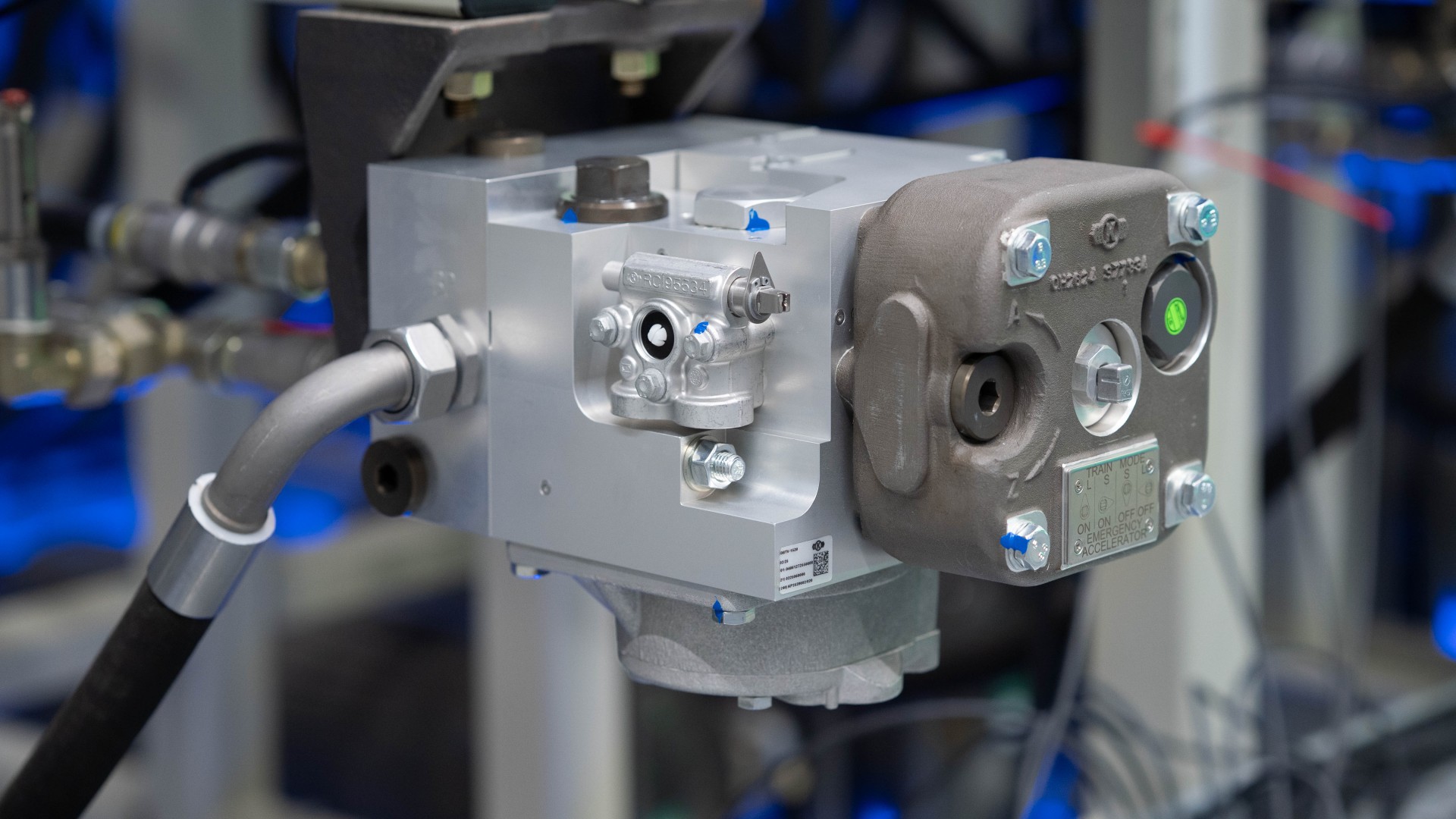
From concept to prototype in just 18 months
An order for 537 passenger railcars undoubtedly represents a major contract. However, even taking account of the number of vehicles concerned (not to mention additional orders that may result from contractual options), developing a GOST K-compliant distributor valve from scratch would have been economically unfeasible due to the sky-high development costs and tight timeframe: The last new passenger car is slated to leave the factory in just six years’ time.
Knorr-Bremse won the brake equipment tender by offering a unique solution: a GOST K-compliant system based on the DBTV valve for AAR freight railcars, upgraded to meet GOST requirements by using technology from Knorr-Bremse’s GOST portfolio (specifically, the KAB60 distributor valve) to, for example, implement the necessary short and long train braking modes. This unusual combination is technically possible not least because both the AAR and GOST standards are based on the direct-release “triple valve”. For the emergency braking function, Knorr-Bremse’s developers resorted to proven components from the company’s UIC portfolio.
For historical reasons, the GOST K standards applied by Kazakhstan’s rail operators are based on standards from the former Soviet Union. Since then, they have been adapted to meet international UIC standards and Chinese regulations, due to the country’s growing collaboration with the Eurasian Economic Union (EAWU). Kazakhstan’s unique approach is intended to facilitate cross-border transportation into and out of the country. The GOST K standard also takes specific local characteristics into account, such as conditions in the country’s steppes and mountainous regions. These impose very specific requirements relating to, for example, the chemical composition of alloying elements, as well as appropriate testing methods.
Thanks to the AAR/GOST/UIC common-parts approach, Knorr-Bremse did not have to develop many brand-new components. Given the short development time – just 18 months from initial concept to prototype – this was a major advantage. Realistically, it would have taken three times as long to develop a new valve from scratch.
Adapting previously approved components
The development team met the remaining requirements by adapting components and assemblies that had already been officially approved. Examples include the integration of all necessary functional elements and control modules in a modified housing, and the addition of valve technology for preventing undesirable activation of the brake pipe accelerator valve if the brake is triggered by a pressure surge (the standard GOST K-approved approach). The team finalized the design by further adjusting the valve’s precision and sensitivity to meet the requirements of the GOST K regulations.
The distributor-isolating device and manual activation function are not mounted on pipework, but instead conveniently located on a panel mounting. The design is similar to that of panels in KZ8A double locomotives for freight trains and KZ4AT passenger train locomotives.
The team was able to completely eliminate any need for the Ls quick bleed valve. In UIC operation, the latter’s precise control of the brake pipe accelerator valve allows train drivers to override the emergency brake if the train is about to make an emergency stop in an exposed location, such as a tunnel or bridge. This function is not provided for the GOST K market simply because specifications do not require a second air supply to back up the main air pipe. Instead, the brake pipe accelerator valve only closes very shortly after the main air pipe has been fully vented.
The team also had to upgrade the distributor valve’s AAR-compliant temperature range (lower limit: ‑43°C) to cope with weather conditions in temperatures as low as ‑50 °C. Where necessary, they changed over to rubber compounds optimized for low-temperature applications. No adjustments were required at the upper end of the temperature range, because both AAR and GOST K standards specify a maximum temperature of +70°C.
No need to reinvent the wheel
In the course of the year, the first 60 new distributor valves were produced in a collaborative project between Knorr-Bremse’s Watertown facility (in New York State) and the company’s Berlin plant. The first half of the batch was intended for simulating an entire trainset as part of the approval process; the other half was delivered to the Stadler Rail plant in Astana for installation in the first passenger railcars.
Official approval of the new distributor valve included one unusual aspect. The room temperature, limit temperature and “shaker” tests were carried out on individual test benches supervised by employees of the Kazakh certification authority – but also on Knorr-Bremse’s Universal Train Test Rig in Munich. In the test rig, the main air pipe – coiled in a large spiral – was used to simulate the braking behavior of complete passenger and freight trains up to three kilometers long and consisting of up to 208 railcars. The valve had already passed room temperature and “shaker” tests back in 2024. The limit temperature tests followed in spring 2025, as did the Universal Test Rig tests for GOST K homologation, using 30 valves connected in series.
Accelerated development based on the common-parts strategy described above shows that sometimes, there is no need to reinvent the proverbial wheel. In the case of the new valve for KTŽ’s passenger railcars, it was sufficient to use a clever combination of the best of three worlds: the AAR freight car valve, the GOST passenger car valve, and a few UIC components. The new valve’s (apt) designation? DBTV-1520, referring to the DBTV valve on which the design is based, and the 1,520-millimeter gauge used in Kazakhstan. (Brutto-Zeichen inkl. LZ: 8.282)

Abstract
The braking systems for 537 new sleeper and couchette cars destined for Kazakhstan feature a new type of valve that cleverly combines multiple AAR, GOST and UIC technologies. Modifications include a common housing to accommodate the adapted functional elements and a brake pipe accelerator valve that complies with GOST sensitivity requirements. Rubber compounds were optimized for temperatures as low as ‑50°C. Development took just 18 months from initial concept to prototype.
(Zeichen inkl. LZ: 479)