Keeping legacy equipment – sometimes decades old – serviced and in good condition requires more than just routine maintenance.
Keeping legacy equipment – sometimes decades old – serviced and in good condition requires more than just routine maintenance. Finding the capabilities, parts, and expertise to keep critical components such as compressors running reliably remains an ongoing challenge across the rail sector. Chris Billett, Manufacturing Manager at Knorr-Bremse, discusses how suppliers are adapting their maintenance strategies to support ageing components.
Railway trains are typically designed to have a service life of between 30 and 40 years. During that time, they will likely undergo a number of routine maintenance services, as well as two or three major overhauls, and at some point probably a complete refresh. This alone poses a challenge for maintainers, which must continue manufacturing or sourcing spare parts for ageing fleets, while also supporting components that may be operating far beyond their design life.
The challenge becomes greater still when you consider the age of the equipment within these trains. A train can take up to 10 years to move from initial design to full service duty, meaning a train which is 30 years old now could well have been specified 40 years ago.
Moreover, the component parts in the train’s systems are unlikely to have been freshly designed when they were first specified. Many will have been selected because they already had years of proven operational service behind them. Consequently, our 30-year-old train could feasibly be carrying components based on designs that are 50 years old or more.
Ageing compressors
Compressed air systems are vital in railway operation. As well as supplying braking systems, they are also a critical component in door actuators, suspension systems, sanders, and other onboard equipment. As such, they must continue operating reliably long after the train first enters service.
Although compressor technology has evolved considerably in recent decades, with advanced materials and improvements to efficiency and reliability, many of the fundamentals of compressor design have remained unchanged. As such, many fleets are still operating equipment designed and installed in the 1960s and 1970s.
These older compressors were designed to be robust, and to be maintained with relative ease. Indeed, their design has clearly stood the test of time. However, keeping them in operation depends on the availability of specialist parts and maintenance capabilities, as well as the expertise to service them effectively.
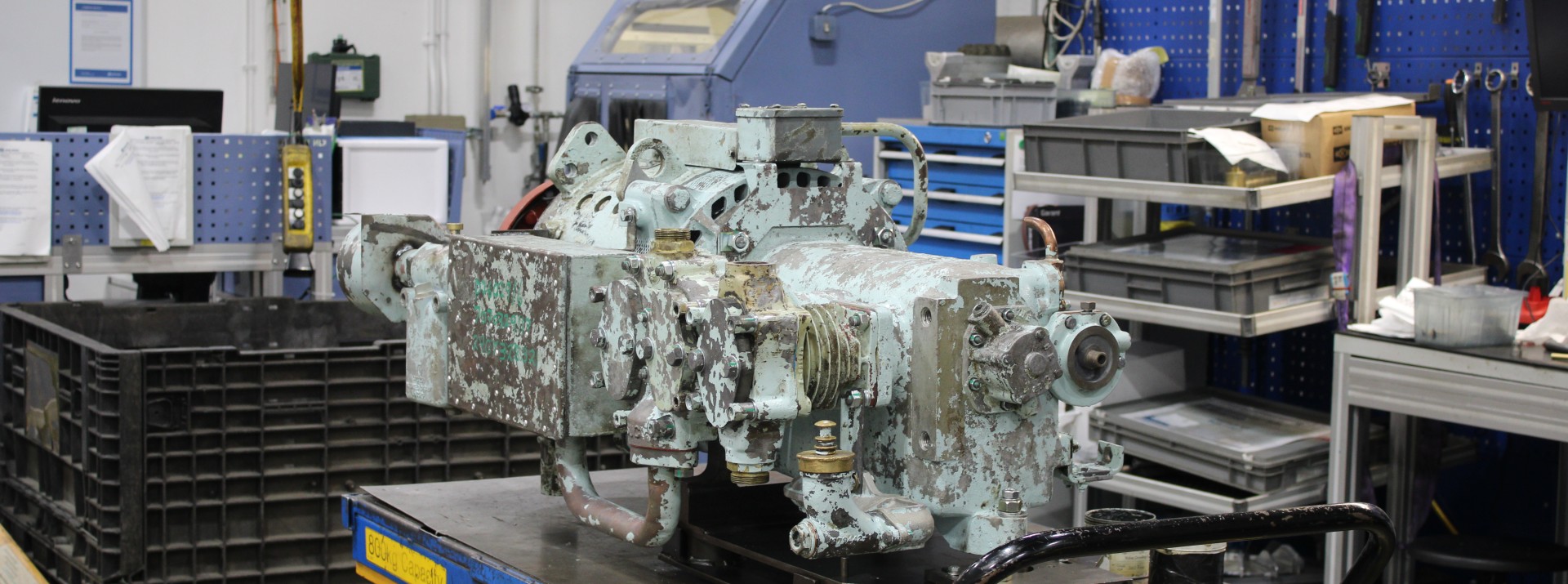
Supporting this installed base requires specialist capabilities. Based in Melksham in Wiltshire, Knorr-Bremse UK is the successor to Westinghouse Brakes, which has manufactured specialised compressors for the rail industry for decades. Starting with two-stage compressors in the 1920s, the design was upgraded to three-stage compressors in the 1960s. These are large pieces of kit, weighing some 600kg each, that were designed to be robust and easy to maintain, so long as the necessary parts and skills are on hand.
The scale of the challenge can be seen across the rail network. Until 2021, train services on the Isle of Wight were operated by Class 483 trains, which had started life as London Underground 1938 tube stock. These replaced the even earlier Class 485 and 486 trains, formerly operated by the London Electric Railway from 1923-31 as its 'Standard' tube stock.
Now, the Island line has been upgraded again to Class 484 trains, converted from London Underground D78 Stock, originally manufactured in the late 1970s and early 1980s by Metro-Cammell and re-engineered by Vivarail in 2021.
This example neatly encapsulates the ongoing nature of the issue of legacy engineering. Even when older trains are withdrawn, they are not always replaced by ultra-modern, state-of-the-art equivalents. As such, there will likely always be a requirement for specialist maintenance support for legacy equipment and components.
Class 150 Sprinters are operated by Northern, West Midlands Trains, Great Western and Transport for Wales, and they first entered service in 1984. London Underground still operates 1972 Stock on the Bakerloo line and 1973 Stock on the Piccadilly, though the latter will shortly be replaced by new trains being built by Siemens at Goole in East Yorkshire.
Addressing the skills gap
As a result, Knorr-Bremse still has to service 1960s compressors on a regular basis. To ensure continued support for these systems, the company retains all of the drawings from the original designs, and employs engineers and fitters with decades of experience working on legacy equipment.
However, as those engineers retire, it becomes increasingly important to transfer their skills and expertise to a new generation. Modern railway maintenance is often centred around digital diagnostics and modular “swap out” servicing. Apprentices therefore also need to learn more traditional techniques, such as how to use micrometer gauges, Engineer’s Blue, and bearing shims to set up mechanical devices – which may have been individually machined with subtly different dimensions – to run true.
Knorr-Bremse works with Make UK, based in Birmingham, releasing its apprentices to learn traditional engineering methods and techniques, mechanically and electrically, before returning to the factory to work on both legacy and modern equipment. For apprentices, it offers opportunities to develop a broader understanding of engineering principles in general, while also providing practical hands-on experience. More widely, it also helps to preserve engineering skills and knowledge that might otherwise be lost as older fleets are withdrawn from service.
Continuing support for legacy systems
Today the rail industry operates a hybrid environment in which modern diagnostic tools and technologies sit alongside equipment – and maintenance techniques – developed decades ago.
This creates an evergreen need for specialist engineering capabilities, particularly for critical components such as compressors. Even as older fleets are replaced or upgraded, large amounts of legacy equipment remain in operation across the network. In many cases, newer generations of rolling stock simply replace older legacy systems with slightly newer legacy systems – essentially kicking the can a few decades down the road. As a result, the challenge of legacy maintenance is often deferred rather than eliminated.
For suppliers and maintainers, there remains a continuous need for availability and continuity – regardless of when the equipment was manufactured. In an industry built around extremely long asset lives, that need will never fully disappear.