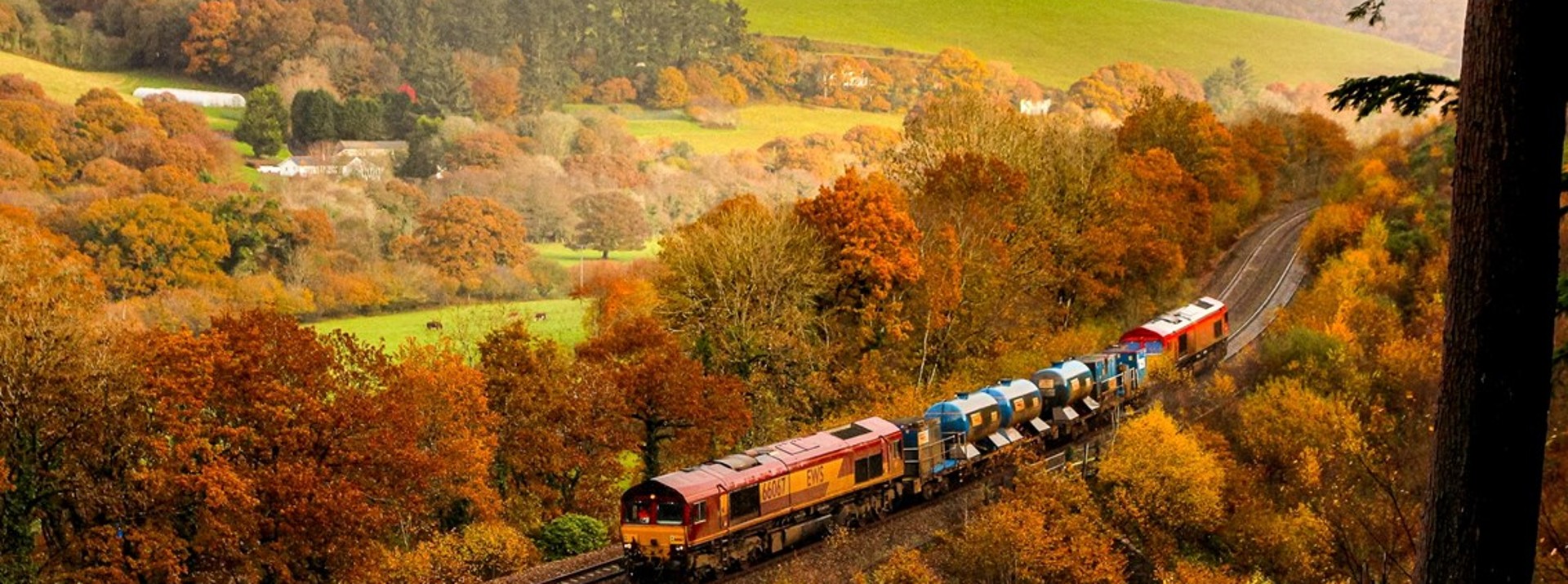
Figure 1A Rail Head Treatment Train cleaning rails in the south west [Credit: Network Rail]
Adhesion is a major operational challenge for the rail sector, particularly during the autumn leaf-fall season. Knorr-Bremse’s Michael Zotter, Sales & Project Manager, explains how intelligent sanding systems are helping operators maintain safe braking performance.
Compared with other forms of transport – cars, buses, trucks – trains are relatively heavy. They also use steel wheels running on steel rails, so the contact patch between the wheel and the rail is relatively small and pressures in that interface are high.
If the adhesion between wheel and rail is reduced for any reason, it will affect braking and acceleration performance, increase stopping distances and compromise operational safety.
By far the most widespread adhesion challenge across the network is autumn leaf-fall season. When leaves fall on the railway, the repeated passage of trains crushes them into a smooth, greasy layer on the railhead that acts like ice on a road surface, dramatically reducing the adhesion between wheel and rail.
To compensate for this, train drivers change their style of driving, leaving more time to accelerate from stations and braking much earlier than they otherwise would. Train operators often change their timetables specifically to accommodate leaf-fall season, resulting in longer journey times for passengers.
Managing low adhesion
While icy roads are treated with grit to improve adhesion, the railway uses sand, applied directly into the wheel–rail interface. This sand cuts through the slippery layer and increases friction, enabling trains to accelerate more reliably and to brake safely.
Applying sand is nothing new. Early systems used first steam and then compressed air to deliver the sand. Today, sanding is often integrated with the train’s Wheel Slide Protection (WSP) system, the rail equivalent of an anti-lock braking system. When the system detects that one wheelset is rotating at a different speed compared to others (indicating slip or slide), it automatically activates the sanders, improving adhesion almost instantly.
Modern sanding systems can apply sand to a single wheelset, while other configurations use multiple sanders to achieve a more effective distribution. Variable-rate sanders adjust the quantity of sand delivered according to vehicle speed, delivering the optimum amount exactly when and where it is needed.
As a result of these improvements, sanding systems have become increasingly common. They are now widely regarded as the standard solution for new trains across Europe and are seen as a key element of safe and reliable rail transport.
Recent incidents
Two recent incidents demonstrate the consequences of poor adhesion, and the importance of effective sanding performance. In October 2021, a South Western Railway service from London Waterloo to Honiton passed a red signal and collided with a Great Western Railway passenger service travelling from Portsmouth Harbour to Bristol Temple Meads at Fisherton Tunnel near Salisbury. Fourteen people required treatment in hospital, while the collision also caused significant damage to the trains and railway infrastructure.
Investigations concluded that wheel-rail adhesion was extremely low at the time of the incident and, although the train that passed the red signal was equipped with sanding equipment, its brakes were not applied sufficiently early to mitigate the low adhesion, and the train was unable to stop in time.
In October 2024, a passenger service from Shrewsbury to Aberystwyth collided head-on with a Machynlleth to Shrewsbury passenger service at Talerdigg, Powys. One passenger died and four other people were seriously injured. In this case, the subsequent investigation determined that, although the Shrewsbury to Aberystwyth train was equipped with sanders, blocked pipes prevented the sand from reaching the wheel-rail interface, leading to the train overrunning its stopping point by approximately 1,080 metres.
These two incidents underline the importance of having operational sanders that can deliver enough sand to the wheel-rail interface to overcome the lack of friction due to leaf-fall residue.
Improving sanding performance
For best performance, a sanding system has to be in good working orderand has to interface well with the Wheel Slide Protection system. As soon as wheel slide is detected, the sanders need to blow sand into the wheel-rail interface.
To be effective, the sander’s nozzles need to be as close to the target as possible – too far away and the sand will scatter and coverage of the rail will be reduced.
Results from a recent RSSB (Rail Safety and Standards Board) research project highlight the difference in stopping distance between a clean and dry rail (300-350 metres) and an unsanded rail in slippery conditions (1,200 metres), with varous sanding systems giving results between those two (see Fig 1).
As well as delivering sand at the right time and in appropriate quantities, the system also need to check that the injectors are working properly. Knorr-Bremse addresses this with a combined approach of sand flow and sand level monitoring. All relevant data is transmitted to the Train Control and Monitoring System (TCMS), where it can be used for condition monitoring, availability assessment and efficient planning of refilling operations.
Together, these technologies transform sanding from a system that requires periodic manual checks into a continuously monitored and data-driven function, improving reliability, maintainability, and safety.