
Expanding public transport and shifting freight transport from road to rail are essential
for reaching ambitious climate goals. ATO over ETCS serves as one lever to increase
capacity, in particular without cost-intensive expansion of the railway infrastructure.
One starting point from brakes and wheel/rail adhesion perspective can be to improve
the confidence level of the vehicle deceleration performance under different conditions
at the same level of safety. Understanding the existing correlations in the wheel-rail
contact forms the basis for potential solutions related to this. During yet another test
campaign performed in 2024 by Knorr-Bremse and DB Systemtechnik, solutions for
the development of this approach were successfully validated. Beyond, important basic
data was generated.
Introduction/Context
The EU’s legally binding goal is to achieve climate neutrality (net zero emissions) by
2050, enshrined in the European Climate Law and the European Green Deal. As a
milestone on the way, the EU aims to reduce net greenhouse gas emissions by 2030 by at
least 55% compared to 1990 levels. These targets are designed to align with the Paris Agreement and ensure that all sectors, and especially transport, contribute to emission
reduction [1].
It is widely recognized that shifting passenger and freight transport from road to rail is
essential for reaching climate goals, as rail is significantly less carbon-intensive than road
transport. Accordingly, the EU aims to expand public transport - especially rail- for both
conventional and high-speed trains. By 2030, rail passenger transport is projected to reach
633 billion passenger-kilometers, accounting for nearly 10% of all transport activity [2].
To be able to manage this overall rising demand for transport, solutions need to be
developed.
Means to expand railway capacity
Direct possibilities for the expansion of transport capacity in rail operation are limited,
particularly due to infrastructure constraints [3]. The situation is additionally fueled by
conflicting interests between increasing capacity versus maintaining stability and
punctuality, both of which are further key performance indicators in rail operation. Since
expanding rail infrastructure is both expensive and time-consuming, the potential to
achieve higher transport capacities with this focus remains limited. Nevertheless, there
are other ways such as operational topics which can be taken into account.
In [4] it can be seen that the dwell time of the trains, linked to passenger entry and exiting
the trains, plays an important role in realizing more efficient rail operation. This is also
confirmed in[5] with focus on transportation in the UK.
The topics of automation and trackside signaling offer additional measures that can be
taken. One example is the Metropolitan Transportation Authority (MTA) in the US
introducing CBTC on multiple lines in New York. This is also done with besides others
the goal of more frequent train runs and higher transport capacity [6].
From [7] we can learn that the braking systems, their performance and responsiveness
have a direct effect on the train headways. This in return influences the line's capacity. A
way of how braking systems influence the considered deceleration and therewith the
performance of trains being then relevant for operation can also be found in [8].
This brings us to the conclusion that improvements within the braking systems do have a
positive effect on railway performance and line capacity. Nevertheless, if this approach
is followed, the improvements need to be considered continuously within an integrated
solution in combination with the signaling system. Otherwise, valuable potential in braking performance as well as potential for improving transport capacity still remain
unused
Approach focusing on brake system and wheel/rail adhesion
The approach followed by the work described in the document on hand focuses on
consideration of optimized and realistic braking performance, especially during low
adhesion conditions. This is done using three pillars. Starting with Adhesion Mapping,
giving an idea about the current wheel/rail adhesion condition up to the consideration of
all available wheel/rail adhesion related measures such as adhesion enhancing measures
and measures to make better use of the existing adhesion. By using these adhesion
management systems, achievable decelerations of rail vehicles can significantly be
impacted, especially under adverse environmental conditions, as present during autumn
operation. This way, such systems can represent an important building block to improve
the capacity, stability and punctuality of the overall railway system, especially when
combined with future ATO operation or ETCS (European Train Control System) based
train protection.
It is considered promising to even reduce the buffers required today using extended,
situation-dependent system knowledge whilst maintaining the same or an even higher
level of safety through higher accountable decelerations [9]. This task is also focused on
by the R2DATO (Rail to Digital Automated up to Autonomous Train Operation) project,
which is being worked on by Europe's Rail Joint Undertaking (Europe’s-Rail). Using
technologies from its Reproducible Braking Distance (RBD) program, Knorr-Bremse
aims to support the project by providing brake and adhesion management solutions,
including systems to determine wheel/rail adhesion
Interaction of functions to allow for best performance
Understanding the existing correlations in the wheel-rail contact forms the basis for
potential solutions to reliably achieve the desired braking performance under different
conditions, including degraded adhesion. Over the years, a plurality of basic data and
knowledge was gathered during multiple tests on test rigs, e.g. the ATLAS (Advanced
Test Laboratory for Adhesion-based Systems) roller rig, and test campaigns on test trains.
Using this knowledge results in solutions for the determination of the adhesion level being
present between wheel and rail and opportunities for its subsequent optimal utilization
during the deceleration phase and where possible also its improvement. Nevertheless, to ensure potential solutions can be taken into account, their use needs to be subject to
certification and homologation.
This concept can be used for both ATO systems and train protection using ETCS. For this
purpose, in both the ATO system as well as in the ETCS, the corresponding deceleration
values can be stored and afterwards chosen based on external parameters such as
wheel/rail adhesion. Whereas a similar approach can be used for ATO compared to ETCS,
the procedure for ATO is less regulated compared to ETCS being responsible for train
safety. This suggests that it is wise to start with the new solutions being considered in
ATO first followed by ETCS.
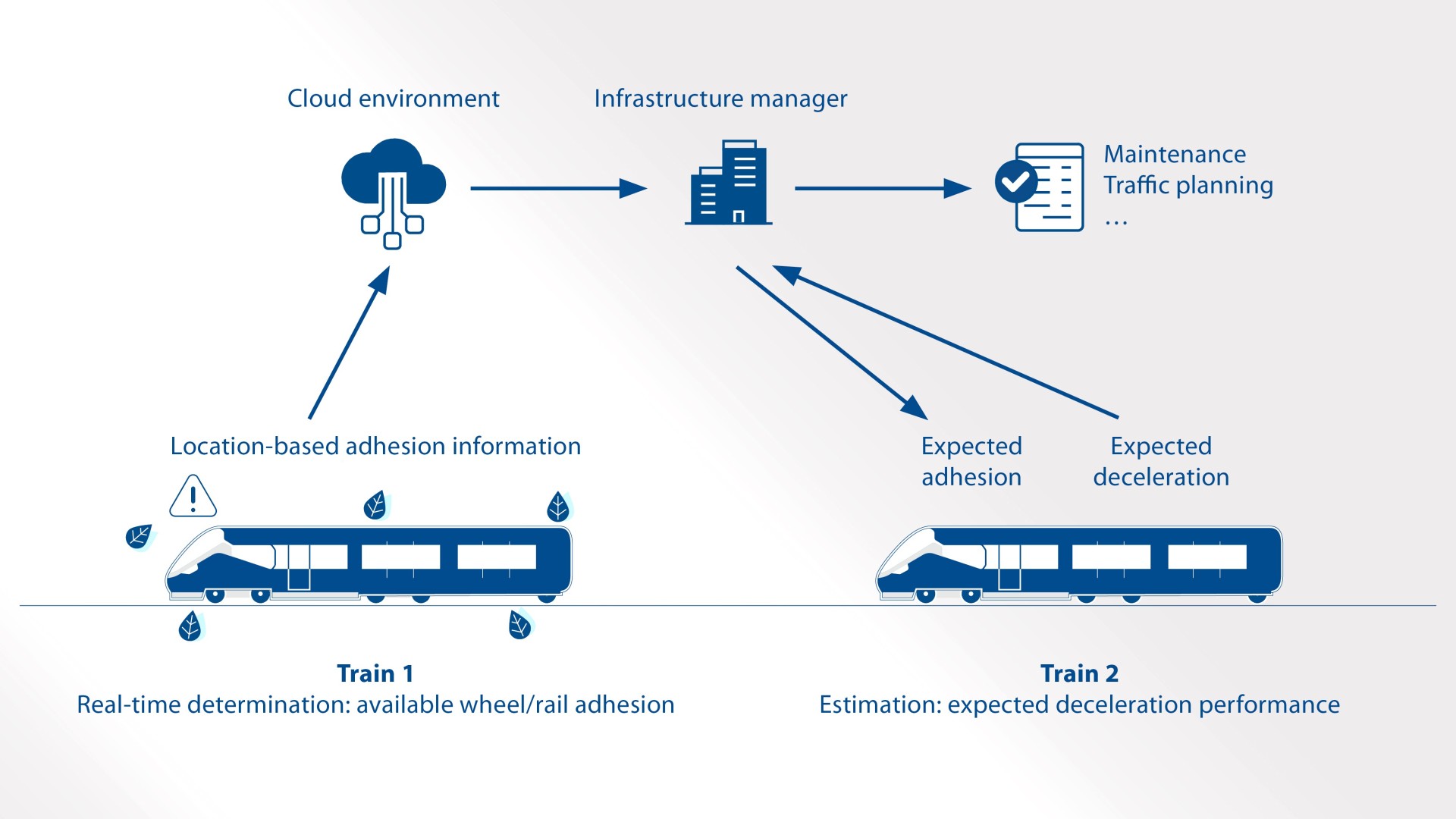
An exemplary operating procedure is described in the following. A first vehicle applies
the brakes on contaminated e.g., leaves-covered or wet, rails and detects an existing
reduced adhesion situation. It then shares the relevant data with the infrastructure
manager via a cloud environment to support the creation of an adhesion map. Using this
information along with further data, e.g. current weather data, the infrastructure manager
can continue processing this data and forward the update to the next approaching vehicle.
This following vehicle, in turn, can then estimate its own deceleration to be expected
while braking in the respective section. Using this information the infrastructure manager
or the ATO system can adjust the traffic planning accordingly (Figure 1). Especially in
an automated system, these additional insights could be leveraged to realise rail operation
which is at the limit of what is currently possible and to reduce the previously very
conservatively calculated time buffers between trains - without compromising safety -
and thereby increase line capacity.
For ETCS (European Train Control System) the UNISIG Subset-026, Part 3 [10]
describes how to handle low adhesion situations within the braking decelerations to be
considered. For this, the correction factor Kwet is of central importance. Kwet is used to
quantify how much the braking performance is reduced when braking in “wet condition”
compared to dry conditions. This is currently based on an adhesion situation specified in
the EN15595 standard [11] on wheel slide protection systems. Currently Kwet values are
fixed for each train, and their use depends on the requirements of the infrastructure
defining whether to use them or not without consideration of the true adhesion condition.
As a fallback, based on driver reporting, other decelerations can be used
(NV_MAXREDADH). More specifications on the determination of Kwet can be found
in [8]. Higher benefits could be achieved if dynamic Kwet values, based on actual
conditions, were used to reliably determine braking distances under low-adhesion rail
conditions. Whereas the Kwet approach is used for ETCS, similar approaches could be used for ATO operation, which would especially be useful to gather experience with such
implementations as the ATO is less safety critical compared to the ETCS. First proposals
showing the adaptation of the trains’ deceleration parameters based on wheel/rail
adhesion are being discussed already.
As enabler for this approach, methods to determine or predict the current wheel/rail
adhesion are known e.g., as implemented in the UK. Implementations of low adhesion
prediction can be found from Met Office using weather models and environmental data
[12].
Knorr-Bremse implemented first building bricks towards the realization of above ideas
and put them under test using the DB aTL (advanced TrainLab) test train. Firstly, a
functional prototype was developed allowing the available adhesion levels to be
determined when passing over a defined position on the track whilst braking. Beyond, the
prototype enables to transfer this information directly to a cloud environment linked to
GNNS-generated position and time information. This way an “Adhesion Mapping” is
realized. Related to improvement of adhesion/ improved adhesion usage, two other
functionalities were put under test. A new wheel slide protection (WSP) algorithm,
Wheelgrip Adapt, making better use of the available adhesion, was tested. The algorithm uses various control strategies during the braking maneuver, depending on the adhesion
levels prevailing at the time, to prevent wheel damage and to minimize the braking
distance. Secondly, an Adhesion Management (ADM) system serves to improve adhesion
levels. Its intelligent control system is used to define the application of sand between
wheel and rail using distributed sanding systems. Unlike conventional systems applying
predefined quantities of sand to a single wheelset per vehicle in a given direction of travel,
the new function distributes the sand application in an intelligently controlled manner at
multiple points along the entire train, dynamically adapting to the actual level of adhesion.
Using the systems and taking them into account, the deceleration relevant for rail
operations (accounted service and emergency brake deceleration) can be increased.
Testing first building bricks of the future overall system
Knorr-Bremse and DB Systemtechnik carried out basic investigations regarding wheel
rail contact in the years of 2019 [13] and 2022 [14]. During yet another joint test campaign
in 2024 performed by the project partners, a number of solutions were now successfully
validated and additional basic data necessary for testing and development of such
approaches was gathered. During the tests, DB's advanced TrainLab (aTL), a diesel
electric multiple unit train was used both on a public track close to Minden (North-Rhine
Westphalia) and on a secluded branch line in Krakow am See (Mecklenburg-Western
Pomerania). The aTL (VT605) is a "future laboratory” on rails used especially for testing
and developing new technologies in real-world rail operations [15].
Before conducting the recent tests, additional sanding systems, adapted brake control
units running the test wheel slide protection (WSP) algorithms (linked to the OE system)
and extensive project-specific data acquisition systems (DAQs) were installed. The latter
one was distributed across the train with over 1,000 channels for recording the
performance of the systems under test. Next to sensors for the determination of axle
speeds, brake- and pilot-pressures, the train deceleration, its position, sand control and
sand flow signals, in addition all internal signals of the adapted brake control units were
recorded. For the determination of the train-wide deceleration value, two Knorr-Bremse
CubeControl brake control units were installed in addition to the actual system involved
in the brake force generation.
Analogue signals from the existing braking system comprising the wheel speeds and
signals for the control of the anti-skid valves were redirected to the test brake control
system running the adaptive brake control under test. To ensure error-free vehicle
operation, the inputs of the existing brake control units were stimulated via a secure control path. This was possible using a special measurement and simulation environment
developed by Knorr-Bremse. All measured data was consolidated synchronously via 12
CAN buses into one single data logger. In parallel, signals which were critical for the
execution of the tests were evaluated and displayed live inside the train in a control center
via a separate and independent DAQ.
The key parameters varied during the tests were the rail conditions and the parameter
settings of the brake and adhesion management systems. Various challenging wheel-rail
adhesion conditions were created using mixtures of water and soap, paper, oil, and leaves
to simulate adverse test scenarios. In total, more than 350 braking maneuvers were
performed.
Results of the dynamic testing
Proof of Concept: Adhesion Mapping
To perform a proof of concept (POC), a prototype of an Adhesion Mapping system was
installed in the aTL. The system was active during all the test campaign. Its task was to
determine data giving evidence of the experienced wheel/rail adhesion condition. It
triggered, recorded and filtered the relevant data (identified adhesion, measured
deceleration, speed, position, detected activity of magnetic track brake and sanding) and
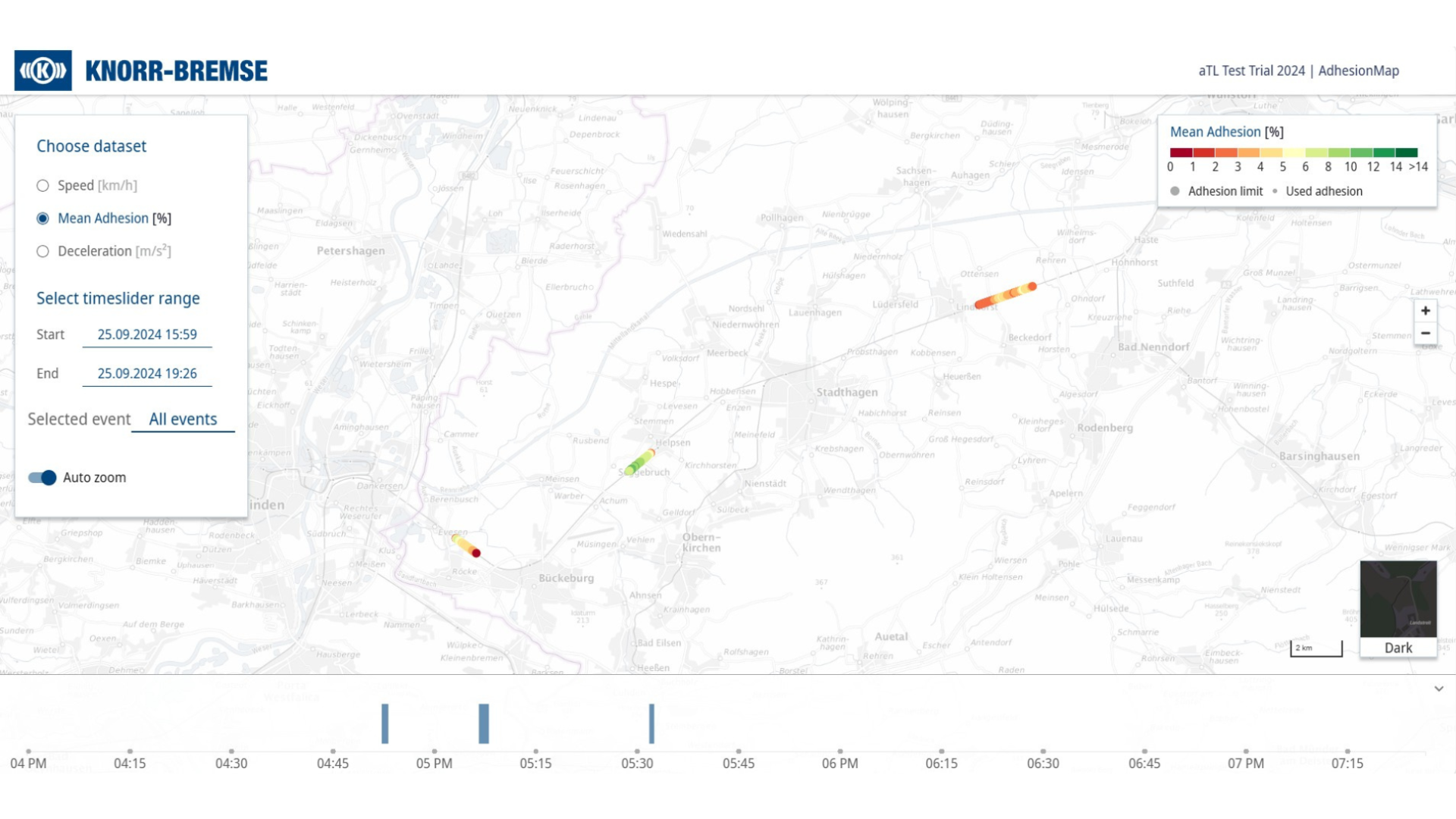
transferred it via GSM to a cloud server. An exemplary web-based user interface
application was implemented which can be adapted to future user requirements.
Using this functionality, it could be shown that it is possible to determine the wheel/rail
adhesion using systems that are already available on board of today’s trains. The
feasibility of representing adhesion data in real-time could be proven. Nonetheless, real
time requirements need to be specified for each specific application, e.g. depending on
the distance spacings between the trains. There might be large differences between
different modes of transport just as high-speed or suburban operation. Although the
available network coverage must always be considered, the data transmission from the
vehicle to the cloud environment for visualization worked smoothly. Once deposited in
the cloud, the data can then be made available to different users (Figure 2). This way the
information can, for example, be used by infrastructure managers to initiate maintenance
measures such as cleaning the rail by means of pressured water. However, subsequent
trains could also utilize the data to assess their expected deceleration performance on this specific part of the track, which may be transferred into operational traffic planning and/or
the ATO control sequences.
Adaptive Wheel Slide Protection (WSP)
During the test campaign, the new WheelGrip Adapt system was tested and it replaced
the OE wheel slide protection system originally implemented in the aTL. At its core, the
employed adaptive algorithm dynamically switches whenever this enables higher brake
forces, to an additional control range, specifically designed for extremely low adhesion
conditions [16]. Main target of the tests carried out was to validate the WheelGrip Adapt
wheel slide protection algorithm. Therefor it was implemented in the test brake control
system and could be (de-)activated during the test alternating with a non-adaptive
algorithm. Using this test setup, the new algorithm’s impact on the utilization of available
wheel-rail adhesion could be quantified in “autumnal conditions”.
Each test series started with an initialization phase, where 500m to 600m of the track was
covered with contamination, especially leaves. Hereafter, the prepared track section was
overrun several times from both directions with brakes being applied. With each overrun
the impact of the leaf contamination decreases, and therefore the available brake force
increases. To be able to identify the benefit of the WheelGrip Adapt against the WheelGrip Classic, after two runs in any of the modes, the configuration of the WSP
system was changed to the other variant.
During the data analysis, the mean deceleration of the train for the prepared section and
achieved using the WheelGrip Adapt or the WheelGrip Classic algorithm was determined
and plotted against the number of overruns (Figure 3).
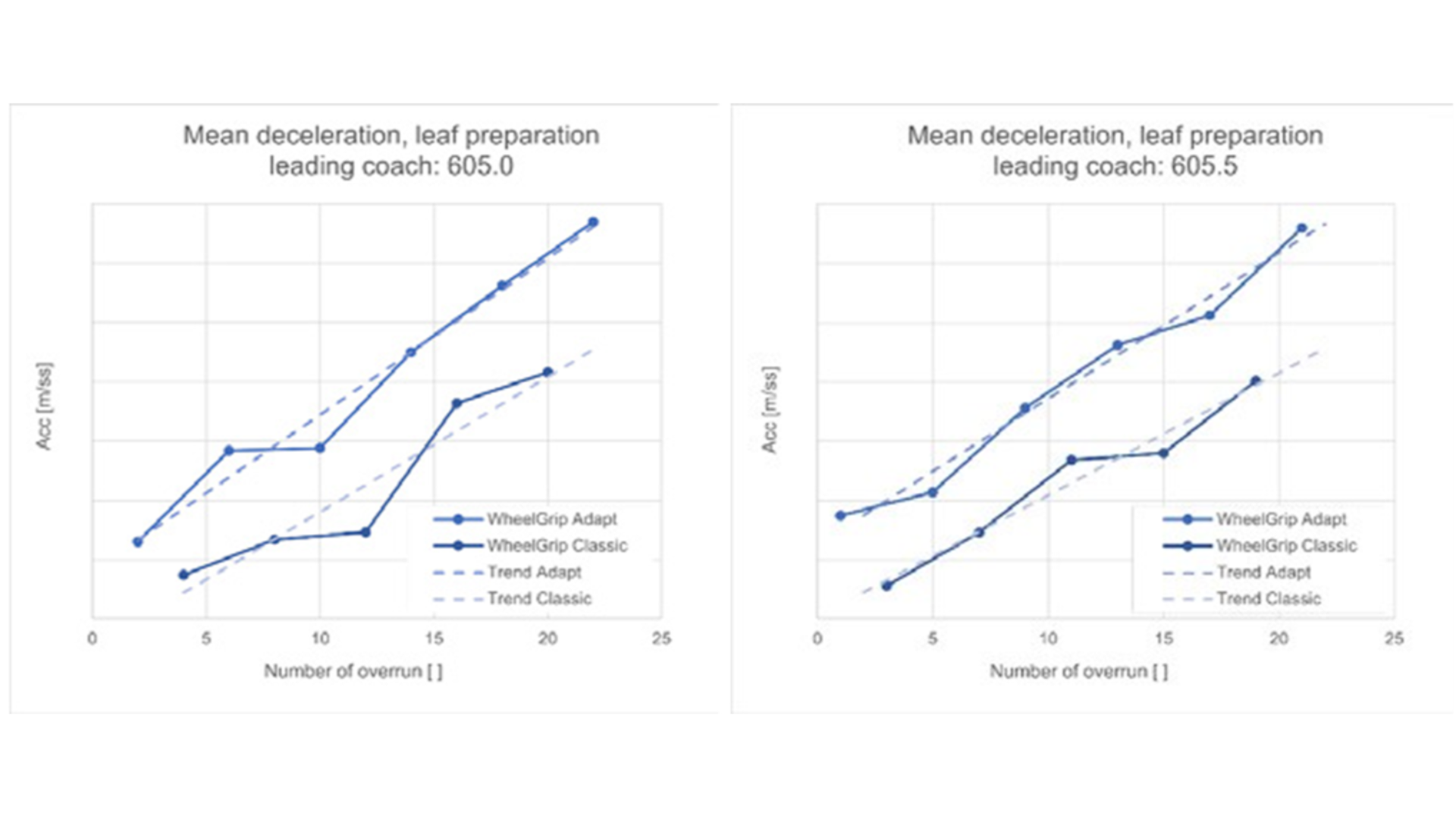
As a result, it could be shown when looking at consecutive overruns, that at all times the
deceleration achieved using the WheelGrip Adapt was in a higher range compared to the
one achieved using the WheelGrip Classic. To be able to compare the solutions using a
numerical value, a linear trend line was determined for each of the resulting curves. Based
on that, the ratio of the WheelGrip Adapt and WheelGrip Classic trendlines was
calculated, split into the two driving directions.
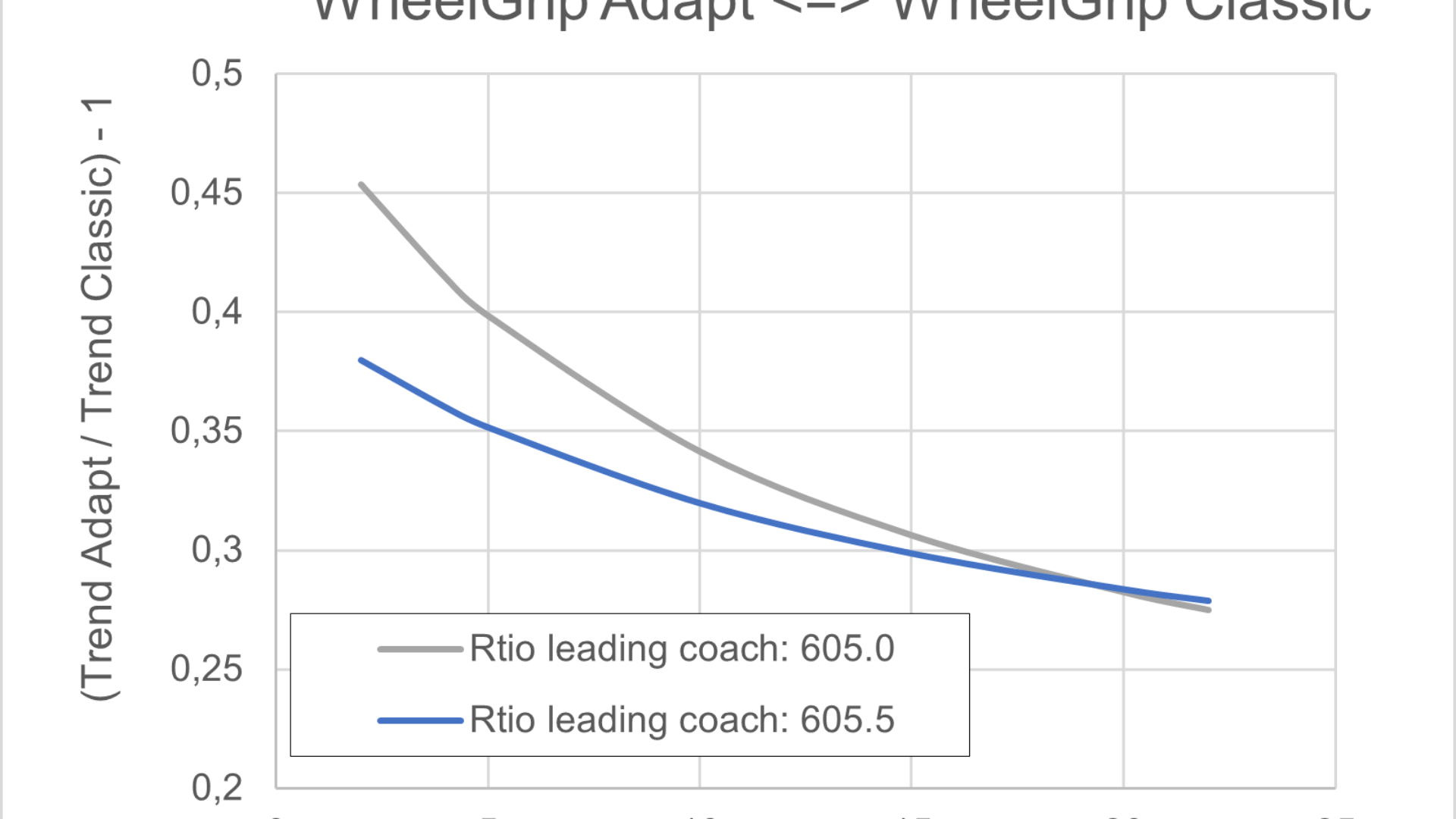
EQU Ratio = trendline(WheelGrip Adapt)/ trendline(WheelGrip Classic) -1.
The performance comparison for the adhesion conditions considered with focus on leaf
application shows a ratio between WheelGrip Adapt and WheelGrip Classic of approx.
0.25 up to 0.45. This indicates an increase of the brake force of 25% to 45% for the
WheelGrip Adapt compared to the WheelGrip Classic algorithm (Figure 4).
The system ran stable and trouble-free during the entire test campaign. Based on the test
results, the algorithm's suitability for approval in accordance with EN 15595 /
UIC Leaflet 541-05 could also be confirmed for the first time using a multiple unit train
at speeds up to 160 km/h. In addition to the WSP specific tests, the system also collected relevant data for the Adhesion Mapping function.
Adhesion Management using braking sand
In addition to sensors and control components necessary for the Adhesion Management
system, a additional sanding units were installed on two aTL bogies distributed along the
train. Their activation was based on deceleration data provided by the wheel slide
protection system.
After initial challenges related to bogie installation of the sanders, the ADM system
worked as expected. The resulting test data sets were comparable with previous tests on
the Knorr-Bremse ATLAS roller test rig in terms of control behavior and influence on
wheel/rail contact. Particularly under low adhesion (nH) conditions, decelerations similar
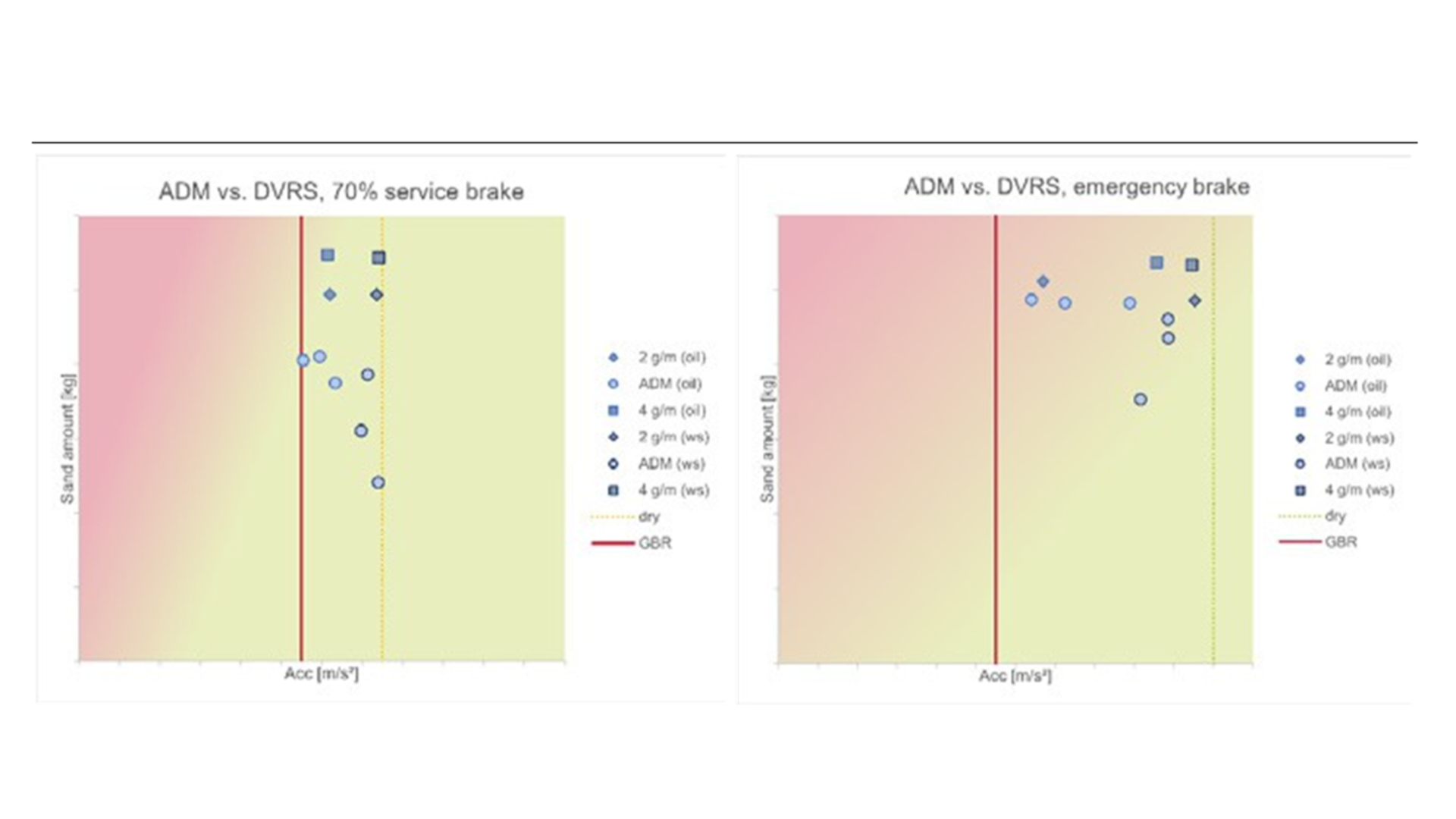
to dry conditions were achieved. Figure 5 shows a test data set for such nH conditions
realized by a water/soap preparation. The ADM system was benchmarked against a 2 g/m
and 4 g/m DVRS system and shows a lower sand amount usage. In addition, the
demanded brake deceleration was almost reached. This is especially the case for brake
stages with lower deceleration demands.
Under very low adhesion conditions (xnH), significantly increased decelerations were
detected. To reach xnH condition, oil preparation was used. The ADM system improves
adhesion in a way to realize a value which is over a minimal needed barrier (GBR). If
possible, the ADM also tries to save sand in these scenarios. As a result, even under
braking on oil-contaminated rails - considered to be the most adhesion-reducing
condition - deceleration consistently remained above 0.55 m/s².
Impact of magnetic track brakes on leaves-contaminated track
The magnetic track brake (MTB) provides additional brake force for trains in case of
emergency brake applications. Not less important is its cleaning effect in case of degraded
adhesion conditions such as leaves in autumn.
Within the previous test campaign in 2022 [14] mentioned above, investigations on the
adhesion improvement on track preparations with paper tape and oil were carried out. For
this purpose, several consecutive braking tests were executed on the same track with just
one initial preparation. This allowed us to evaluate the increase of adhesion between
consecutive wheelsets of the train as well as for subsequent trains on the same track. The
test sequences were performed with and without magnetic track brake (MTB), to be able
to quantify the additional adhesion improvement caused by the MTB.
During the test campaign in 2019 [13], the comparability between contamination
generated by paper tape and leaves related to the general adhesion conditions for single
braking actions without MTB was already proven.
As a next step within the current test campaign one aim was to investigate the
comparability between paper tape and leaves contamination regarding the long-term
effects of brake applications with and without MTB as mentioned above.
Figures 6 and 7 each show two test series using leaves respectively paper tape as
preparation for a 500 m section of the test track. Each of the test sequences starts with a
new preparation of either leaves or paper tape and consists of 12 emergency brake applications for this preparation. Throughout each single braking test, water was applied
in front of the leading wheelset in the direction of travel. In the upper test sequence of
both graphs, the MTBs installed in bogie no. 1 and 6 were activated in every second test
to examine their impact on the adhesion conditions. The lower test sequences in the
graphs consist exclusively of tests without MTB usage.
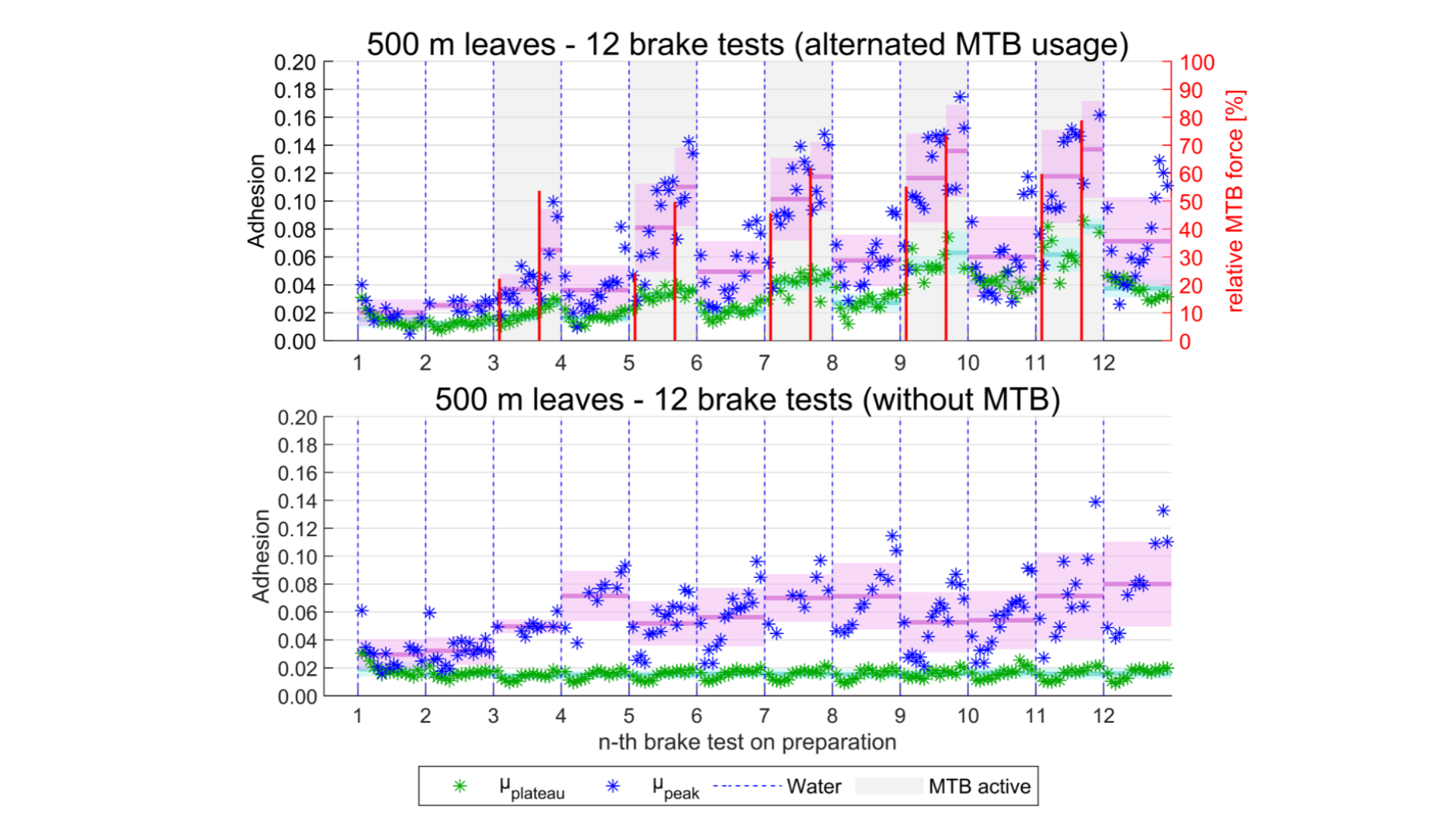
The plots show the relative MTB brake force of both MTBs (vertical red lines, scaled at
the right y-axis) and two characteristic adhesion values for each of the 16 wheelsets
(scaled at the left y-axis). The relative MTB force relates to the transmittable force on dry
rail at the same speed. The adhesion of each wheelset was characterized by the two values µpeak (blue asterisk) and µplateau (green asterisk), where µpeak is the maximum adhesion value before the wheelset starts sliding. µplateau is the mean adhesion at sliding speeds above 10 kph, calculated as integral over the braking distance. The boxes and horizontal lines define the standard deviation resp. mean values of µpeak (magenta) and µplateau (cyan) for a group of wheelsets. This group consists of all 16 wheelsets in case of inactive MTB.
For tests with active MTB, the standard deviation and mean values were calculated for
the wheelsets 2 to 11 between the first and the second MTB and for the wheelsets 12 to 16 behind the second MTB. This allows for showing the increase in adhesion that was
caused by each active MTB.
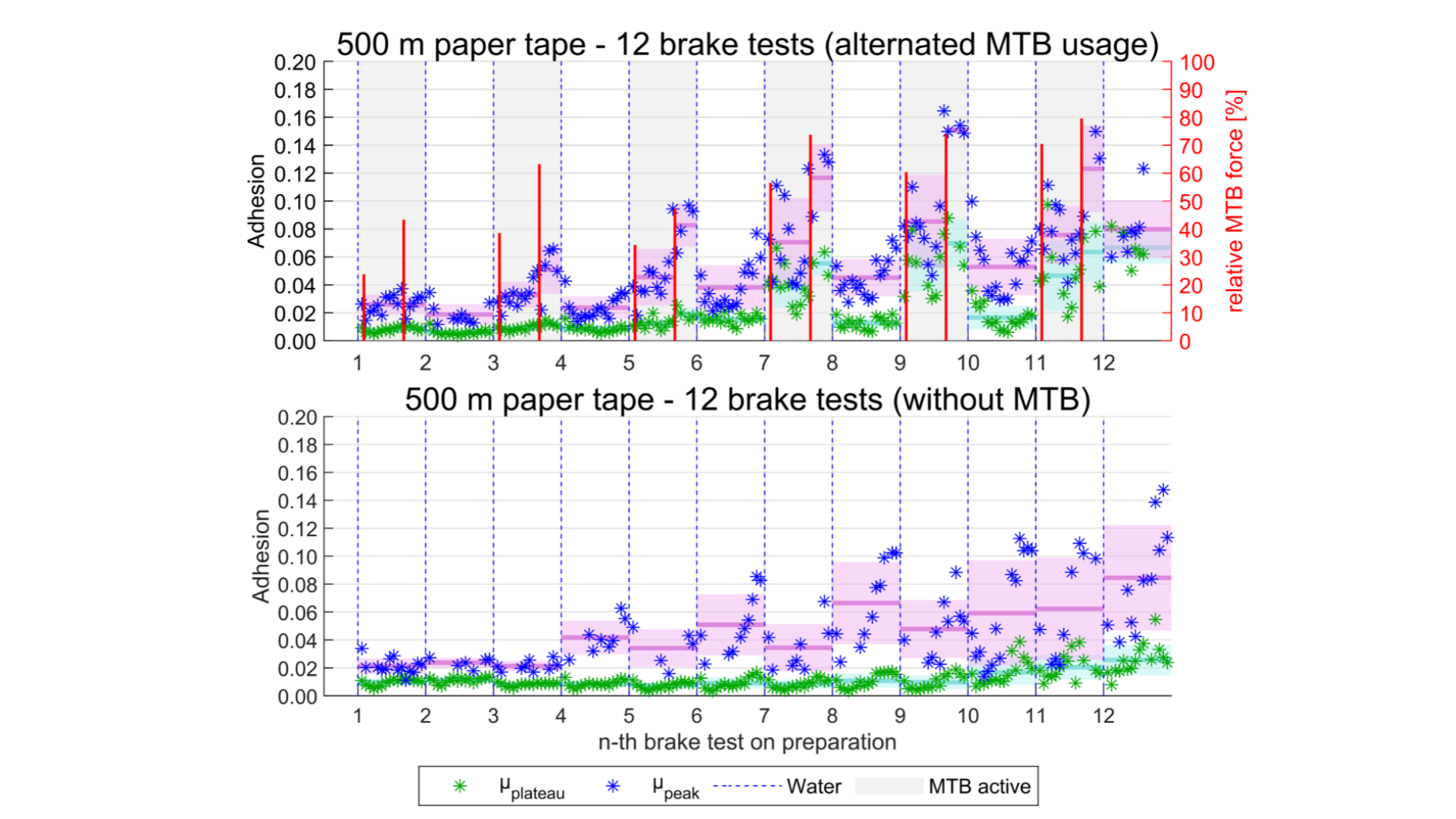
Both the test series on leaves and on paper tape show quite comparable behavior regarding the cleaning effect with and without MTB as well as related to the transmittable brake force of the MTB itself.
In both test series (leaves/ paper tape) without MTB, the adhesion in macro slide (µplateau) is neither increasing significantly from wheelset to wheelset within each single braking test, nor from one test to the next. However, there is a minor conditioning effect even in those extremely low adhesion conditions, that leads to increasing peak adhesion values from wheelset to wheelset within each test. Water being applied in front of the first
wheelset in the direction of travel during the next braking test resets this effect almost
ending up at the initial value of the previous braking test. Accordingly, this conditioning
effect is mainly caused by displacing the water with each wheelset rolling over it. The
reason for this is that the third body layer on the rail head (leaves as well as paper tape)
only leads to extremely low adhesion conditions when combined with water. The wear of the third body layer itself is a minor effect only as long as the MTB is inactive, so that the
overall adhesion level does not increase significantly from test to test.
The test series with MTB on leaves and on paper tape shows that in both cases the
wheelsets behind each MTB being active benefit from its cleaning effect, as the MTB
displaces a significant amount of water from the rail head. This leads to a significant
increase of peak adhesion as well as the transmittable braking force of the second MTB.
By applying water during the next braking test, the adhesion level decreases, but
compared to the test series without MTB, there is a major superimposed conditioning
effect that increases the adhesion (especially µpeak, but also µplateau) from test to test. That this effect cannot completely be reset again by application of water, leads to the
conclusion that it is caused by the wear of the third body layer due to the MTB being
active.
Both track preparations, leaves and paper tape, lead to a third body layer on the rail head,
the so called “black leaf layer”. This contaminant leads to extremely low adhesion
conditions if water is applied to it. The analysis of the measured data leads to two
conclusions, related to track preparation and MTB usage. First it showed that preparation
with leaves and with paper tape both lead to comparable adhesion conditions that behave
identically, especially regarding the conditioning effect at multiple overruns. Second, it
can be derived that the use of MTBs immediately helps to increase the usable adhesion
of the current train by drying the rail head but also has a long-term effect by wearing the
third body layer.
Of strategic relevance is the consistency of the effects of the wheel slide protection
system, the usage of sand and magnetic track brake experienced during the test runs with
simulation results obtained previously.Being able to reproduce these effects in simulation
models is a prerequisite for transferring aspects of real-world test runs to simulation test
rigs. Given the (very) limited availability of suitable test tracks, this approach could be
used to further develop DB Systemtechnik’s well-established procedure of combining the
results of simulation test benches with real-world tests for the certification of wheel slide
protection systems. Due to the limited availability of the necessary test tracks and in order
to reduce the effort required for vehicle tests (costs, time), the partial implementation of
the tests using simulations is an obvious choice.
Conclusions and next steps
The latest series of tests once again showed promising results, confirming the
functionality and effectiveness of adhesion-based solutions to support later ATO (under ETCS) operation and to support certification of wheel slide protection systems using test
rig tests.
Related to the support of automated operation, as a first pillar, the capability of Adhesion
Mapping with equipment already on board of today’s trains was shown. Secondly, the
effectiveness and readiness for approval of an improved adaptive WSP algorithm could
be shown. Furthermore, the ability of an intelligent Adhesion Management system to
efficiently increase prevailing wheel/rail adhesion conditions by using as little sand as
possible was demonstrated. In the next step, especially the Adhesion Mapping
functionality is aimed for being tested in an even more realistic environment under regular
operation. The adhesion management will be enhanced by further functionalities.
Beyond, development efforts will increasingly focus on integrating the tested building
blocks into a harmonized overall system. In parallel, it will be essential to advance the
definition of certification/ homologation requirements for such adhesion-based solutions
to enable their use for future ATO/ ETCS applications.
The basic data related to the effect of the MTB will be integrated into the simulation
model of the WSP test rig environment. This enhances the possibility to migrate further
tests from track testing to simulation test benches. Besides classical WSP testing, this
simulation could also be used for testing and certification of other systems whose
performance is affected by the available adhesion, like deceleration control, ATO or
ETCS systems.


Funded by the European Union. Views and opinion expressed are however those of the author(s) only and do not necessarily reflect those of the European Union or the Europe’s Rail Joint Undertaking. Neither the European Union nor the granting authority can be held responsible for them. The project FP2-R2DATO is supported by the Europe’s Rail Joint Undertaking and its members.
References
[1] European Commission: Climate action and the Green Deal. Unknown date.
https://commission.europa.eu/strategy-and-policy/priorities-2019-2024/european-green
deal/climate-action-and-green-deal_en; 14.07.2025.
[2] European Environment Agency: Passenger transport activity. 10.10.2024.
https://www.eea.europa.eu/en/analysis/publications/sustainability-of-europes-mobility
systems/passenger-transport-activity; 14.07.2025.
[3] Umweltbundesamt. Schienennetz 2025/2030 – Ausbaukonzeption für einen
leistungsfähigen Schienengüterverkehr in Deutschland.
https://www.umweltbundesamt.de/sites/default/files/medien/461/publikationen/4005.pd
f; 16.07.2025.
[4] TCRP Report 13: Rail Transit Capacity, 1996.
[5] Barron, Alex in: Dwell time reductions: Good design plus people management.
Railway Technology Magazine. Dec/Jan 2016,
https://www.railtechnologymagazine.com/Comment/dwell-time-reductions-good
design-plus-people-management; 14.07.2025.
[6] CBTC: Upgrading signal technology. https://www.mta.info/project/cbtc-signal
upgrades; 14.07.2025.
[7] Jähnichen, Dieter (Hrsg.): Handbuch Bremstechnik von Eisenbahnfahrzeugen; GRT,
2023.
[8] DIN EN 17997:2025: Railway applications – Braking – Definition of ETCS brake
curve parameters for Gamma trains.
[9] Braeseke, J./ Fischer, M./ Friesen, U./ Gräber, J. in: Fahrzeugseitige Optimierung
der Infrastrukturauslastung: RBD-Testfahren & Feldversuche. ZEVRail, Ausgabe
06/07 2023.
[10] ERTMS/ ETCS System Requirement Specification, Chapter 3, Principles, issue
3.6.0, SUBSET-026-3; 13.05.2016.
[11] DIN EN 15595:2018+A1:2023: Railway applications – Braking – Wheel slide
protection.
[12] Met Office. Rail Sector Services.
https://www.metoffice.gov.uk/services/transport/rail/index; 18.07.2015. [13] Fischer, M./Haselsteiner, K./Szekely, F./ Heinz, S./Kröger, F. in: Mehr Mobilität
auf der Schiene: Erhöhung der Transportkapazität durch Optimierung des
Kraftschlusses. ZEVRail. Ausgabe 10 2020.
[14] Fischer, M./Rasel, T./Ebner, B./Kröger, F./Heinz, S. in: Investigations of degraded
adhesion conditions and interrelated methods for improving raking performance using
the advanced TrainLab (aTL). EuroBrake 2023, Barcelona. 12. September 2023.
[15] Deutsche Bahn. Our future lab runs on rails.
https://nachhaltigkeit.deutschebahn.com/en/measures/advanced-trainlab; 14.07.2025.
[16] Meyer, R./Rasel, T. in: Höhere Zugtaktung: Neuartiger Gleitschutz für eine
verbesserte Auslastung der Schieneninfrastruktur. ZEVRail. Ausgabe 11/12 2020.
Authors
Dr. Fischer, Marcus, Kröger, Felix, Rasel, Thomas, Kreisel, Norman,
Stumm, Sebastian